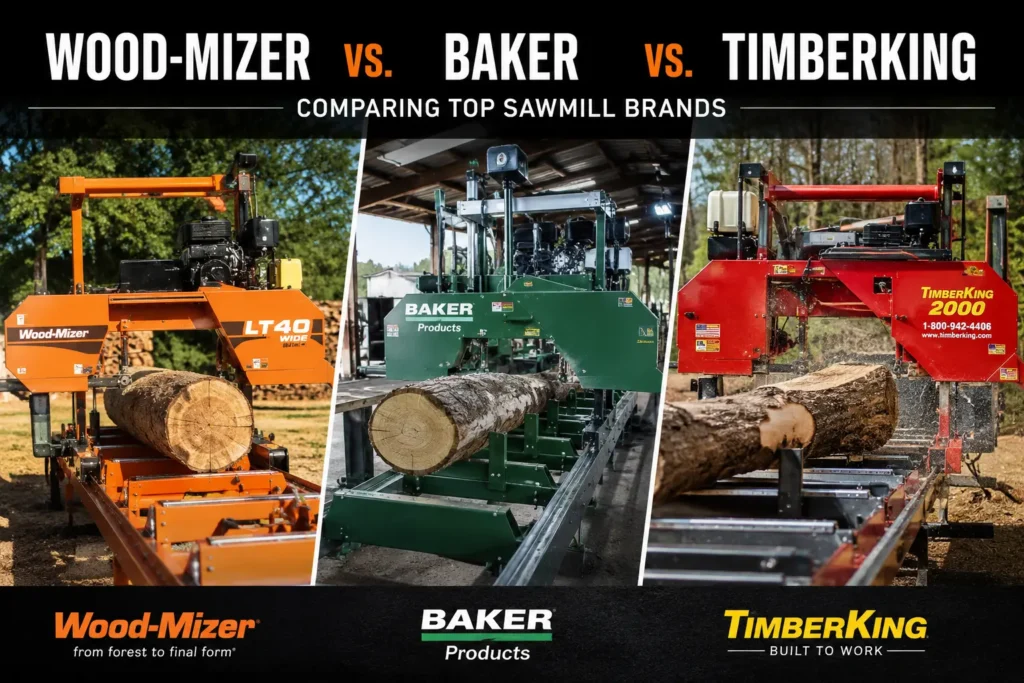
Ask five different sawmill owners which brand they’d recommend, and you’ll likely get three or four different answers. Usually with a strong opinion attached. That’s not because two of them are wrong. It’s because Wood-Mizer, Baker, and TimberKing built their reputations solving slightly different problems for slightly different operators.
If you’re trying to decide between them, the goal isn’t finding the “best” brand in the abstract. It’s finding the one that matches your log size, your budget, and the kind of milling you’re actually going to do. This guide walks through what each brand is genuinely known for, where they differ, and how to think through the decision.
Why Brand Reputation Actually Matters Here
A sawmill is a long-term purchase. You’re not just buying a machine. You’re buying into a company’s parts availability, service network, and design philosophy for the next 10 to 20 years of ownership.
This is where brand history becomes more than trivia. A manufacturer that’s been refining the same core design for decades has usually already fixed the problems a newer company is still discovering. It also tends to mean parts are easier to find, whether you’re buying new or shopping the used market years down the road.
With that in mind, here’s what actually sets these three brands apart. If you’re still working out which category of mill fits your business plan in the first place, our guide on how to start a sawmill business is worth reading alongside this one.
Wood-Mizer: The Portable Band Mill That Defined the Category
Wood-Mizer’s story starts in 1982, when Donald Laskowski and Daniel Tekulve patented the first LT30 sawmill. That single model helped create the modern portable band sawmill industry. The company built over 2,500 units in its first five years alone. Today, Wood-Mizer says it has sold more than 100,000 sawmills across over 100 countries.
What Wood-Mizer is known for:
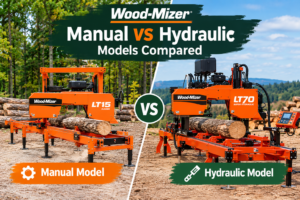
- The widest model range of the three brands — from the entry-level LX series and LT15 for hobby and homestead use, up through the LT40, LT50, and LT70 series for commercial production
- Strong hydraulic log handling on its higher-end models, cutting down manual labor on bigger jobs
- One of the largest dealer networks in the portable sawmill industry, which matters for service and parts access wherever you’re located
Best fit for: Buyers who want a wide range of size options under one brand. That could mean a first sawmill for weekend milling, or a full commercial setup later, without switching manufacturers as they grow. The size of the Wood-Mizer dealer network is also a real advantage if local service support matters to you. Browsing sawmill equipment for sale is a quick way to see current Wood-Mizer listings alongside the other brands covered here.
💡 Pro Tip If you’re not sure how much mill you’ll eventually need, buying into a brand with a wide model range makes it easier to upgrade later. You keep the same blade type, accessories, and dealer relationship as you grow.
Wood-Mizer’s model range covers almost every use case on its own. But if your priority is raw ruggedness over model variety, TimberKing takes a different approach.
TimberKing: America’s Oldest Portable Sawmill Manufacturer
TimberKing’s roots go back to 1929, under the original name Belsaw. Its first product, the Belsaw circular mill, stayed in continuous production until 1998 — nearly 70 years on one design. TimberKing moved into portable band mills in 1989. Since then, the company has leaned on being first to market with several features that later became industry standard, including hydraulic bi-directional log turners and hydraulic roller toe-boards.
What TimberKing is known for:
- A reputation for heavy, solid-welded construction, marketed around durability over decades of use
- Being first to introduce several hydraulic handling features that later became industry standard
- A strong presence in the used-equipment market, since older TimberKing mills tend to stay in working condition for a long time
Best fit for: Buyers who prioritize long-term mechanical durability over the latest feature set. TimberKing’s reputation is built almost entirely on machines that keep running for decades. That shows up clearly in how often older units resell in working condition.
If TimberKing’s reputation is about rugged longevity, Baker’s is about something more specific. It’s about solving a production bottleneck most sawmill buyers don’t think about until they hit it.
Baker Products: Built Around the Band Resaw
Baker’s history is different from the other two. Founder Ed Baker developed his first band resaw in the early 1980s out of necessity. His own pallet mill was facing rising cant prices and needed a way to get more usable lumber out of each log. That resaw-first origin still shapes the brand today.
What Baker is known for:
- A strong reputation specifically in band resaws and multi-head saw systems, alongside its band sawmill line
- Long-tenured, specialized manufacturing — some of the same technicians building Baker’s multi-head saws today have been with the company for 20-plus years
- A customer base that skews toward pallet mills, resaw operations, and mid-size commercial producers rather than hobbyist or homestead buyers
Best fit for: Operators focused on maximizing yield from every log. That especially includes pallet mills, resaw-heavy operations, and commercial producers running Baker’s bandmill and resaw combination as a system, not a single standalone mill. Blade choice matters just as much in this setup as the resaw itself — our guide on sawmill blades covers how tooth pattern and kerf affect yield on any brand of mill.
Side-by-Side Comparison
| Wood-Mizer | TimberKing | Baker | |
|---|---|---|---|
| Founded | 1982 | 1929 (as Belsaw) | Early 1980s |
| Known for | Widest model range, largest dealer network | Rugged, solid-welded durability | Band resaws, multi-head systems |
| Best for | Hobby through commercial, one brand across the range | Long-term durability, traditional design | Yield-focused, resaw-heavy operations |
| Used market | Very active, wide model availability | Strong resale value, long working life | More common in pallet/commercial circles |
How to Choose Between Them
A few questions narrow this down faster than comparing spec sheets line by line.
Are you buying one mill to grow into, or a system to run at volume? If you want one brand to cover you from a first hobby mill through a future commercial upgrade, Wood-Mizer’s range makes that easiest. If you’re building a resaw-centered production line from the start, Baker’s specialization is hard to match.
How much do you value mechanical simplicity versus features? TimberKing’s reputation leans toward simpler, heavier-built machines. They prioritize longevity over the latest hydraulic feature set — a real advantage if you’d rather have fewer things that can break.
What does the used market look like near you? All three brands show up regularly in used listings, but availability varies by region. Check reliable sawmill equipment for current listings across brands before locking in a decision based on new pricing alone.
Buying Used: What to Watch for by Brand
All three brands have a strong presence on the used market. A few brand-specific things are worth checking before buying secondhand.
Used Wood-Mizer mills are common enough that parts and dealer support are rarely a problem, even on older models — a real advantage when comparing used-market options.
Used TimberKing mills often have a lot of working life left, even at higher hour counts, given the brand’s reputation for solid-welded construction. A well-maintained used TimberKing can be a strong value play.
Used Baker equipment — especially resaws and multi-head systems — shows up more often through commercial and pallet-industry sellers than general consumer listings. It’s worth checking industry-specific marketplaces alongside general equipment sites.
Whichever brand you’re leaning toward, the same inspection discipline applies. Our guide on inspecting a used sawmill before you buy covers the condition checks that matter regardless of manufacturer.
⚠️ Safety Reminder Brand reputation for durability doesn’t replace a hands-on inspection. Even the most rugged design can hide worn guides, a stretched blade, or deferred maintenance that only shows up once you look closely.
Cost of Ownership: Beyond the Sticker Price
New pricing across all three brands overlaps more than most buyers expect, since model size and options drive price far more than brand name alone. The real difference shows up over the ownership period, not on day one.
Wood-Mizer’s wide dealer network can mean faster access to parts and service, which shortens downtime when something breaks. That convenience is worth factoring in alongside sticker price, especially if you’re far from a major dealer for a competing brand.
TimberKing’s heavier, solid-welded construction tends to mean fewer structural repairs over a long ownership period, even if it costs a bit more to ship or move given the added weight.
Baker’s resaws and multi-head systems represent a different kind of cost calculation entirely — the return comes from yield improvement on every log processed, not just the upfront machine cost. For a high-volume operation, that yield gain can offset the initial investment faster than a simple price comparison suggests.
None of this shows up on a spec sheet. It’s worth asking current owners of each brand, in forums or local sawmill groups, what their actual multi-year cost of ownership has looked like. Whichever brand you choose, staying on top of routine service matters just as much as the initial pick — our sawmill maintenance checklist covers the upkeep that keeps any of these three brands running at their best.
A Quick Decision Snapshot
If you’re still weighing options, here’s a shorthand version of the guidance above:
- Want one brand to grow with, from hobby to commercial? Look at Wood-Mizer first.
- Want the most rugged, simplest machine that will run for decades? Look at TimberKing first.
- Building a production line focused on maximizing yield per log, especially for pallets? Look at Baker first.
- Not sure yet, and budget is the main constraint? Compare current used listings across all three before deciding, since availability and pricing shift by region and season.
Common Mistakes When Comparing Sawmill Brands
A few patterns show up often among buyers choosing between these brands:
- Focusing only on horsepower and log capacity, while ignoring dealer and service network access in their specific region
- Assuming the most popular brand is automatically the best fit, rather than matching the brand’s specialization to their actual use case
- Skipping the used market entirely, on the assumption that quality equipment only comes new
- Not checking parts availability for older models before buying secondhand, especially outside a brand’s core lineup
Frequently Asked Questions
Which is better: Wood-Mizer, Baker, or TimberKing?
There’s no single “better” brand. Each has a different core strength. Wood-Mizer offers the widest model range and largest dealer network. TimberKing is known for rugged, long-lasting construction. Baker specializes in band resaws and multi-head systems, making it a strong fit for yield-focused or pallet operations.
Which sawmill brand has the best resale value?
TimberKing and Wood-Mizer both hold value well on the used market. That’s largely thanks to their reputation for durability and the sheer volume of units in circulation, which keeps parts availability strong even on older models. Baker equipment holds value well too, particularly in commercial and pallet-industry circles where its resaws stay in steady demand.
Is Wood-Mizer or TimberKing better for a beginner?
Wood-Mizer is often the easier starting point for beginners. Its entry-level LX and LT15 series are built specifically for hobby and homestead use, backed by a large dealer network for support. TimberKing mills tend to skew toward a more traditional, hands-on operating style that some new owners find takes a bit more practice to master.
Does Baker make portable sawmills, or just resaws?
Baker makes both band sawmills and resaws, but its strongest reputation is in band resaws and multi-head saw systems. Buyers focused purely on a single portable mill often compare Wood-Mizer and TimberKing first. Those building a higher-yield production line look closely at Baker’s resaw lineup instead.
How old are these sawmill brands?
TimberKing is the oldest of the three, founded in 1929 under the name Belsaw. Wood-Mizer and Baker both trace their origins to the early 1980s. Wood-Mizer patented its first portable band mill in 1984, and Baker developed its first band resaw around the same era.
Can I mix brands, like a Wood-Mizer mill with a Baker resaw?
Yes, and many commercial operations do exactly this. It’s common to pair a primary mill from one brand with a resaw, edger, or other secondary equipment from a different manufacturer, based on which brand does that specific job best. Compatibility mostly comes down to log dimensions and infeed setup rather than brand matching.
Bringing It Together
None of these three brands is a wrong choice. They’re built around different priorities. Wood-Mizer gives you range and dealer support. TimberKing gives you decades of rugged, proven construction. Baker gives you resaw and yield expertise that’s hard to match if that’s your actual bottleneck.
The right pick comes down to matching the brand’s core strength to what you’re actually trying to do with the mill — not which name comes up most often in a general search. Once you’ve narrowed it down, comparing current listings across all three brands is the fastest way to see what’s actually available near you, new or used.
For more guides like this, browse our full blog archive.
Sources
- Wood-Mizer, Our History
- Wood-Mizer USA, Portable Sawmills
- TimberKing, The TimberKing Story
- Pallet Enterprise, Baker Products Celebrates Its 20th Anniversary