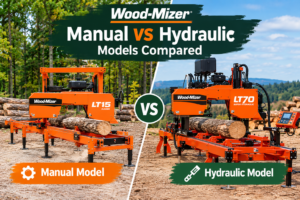
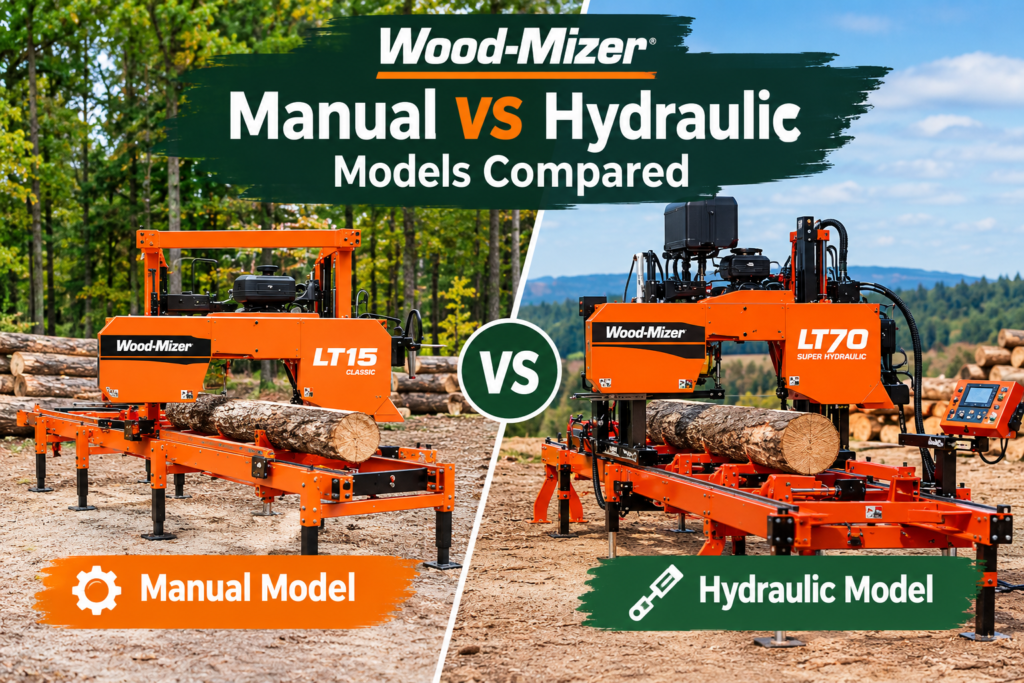
Pick up any Wood-Mizer brochure and the first split you notice is simple. Some mills are manual. Others are hydraulic. The price gap between them can run well into five figures, so it’s fair to ask what that money actually buys.
This guide breaks down Wood-Mizer manual vs hydraulic models in the order most buyers think it through. First, what the two terms really mean. Then how the lineup divides, what changes in daily labor and speed, what the step up costs, and who should stay manual. If you’re already comparing machines, you can browse Wood-Mizer sawmills for sale while you read.
What “Manual” and “Hydraulic” Actually Mean
Every portable sawmill has four log-handling jobs. Someone or something has to load the log onto the bed, turn it between cuts, level it, and clamp it in place.
On a manual mill, you do those jobs yourself. You roll logs up ramps, turn them with a cant hook or an optional manual turner, and tighten a clamp by hand. On a hydraulic mill, an engine-driven pump powers loading arms, a log turner, leveling toeboards, a clamp, and side supports. You run them from the controls.
Here’s the part that surprises many buyers. “Manual” does not mean a hand-cranked saw head. Wood-Mizer’s LT35 manual has powered head controls and SimpleSet setworks, the same as the hydraulic version. The difference is log handling, not sawing.
So where does the line fall across the whole lineup?
Where the Wood-Mizer Lineup Splits
Wood-Mizer groups its portable mills by how much work the sawyer does. Here is the split, based on the manufacturer’s own categories.
| Class | Models | Log handling |
|---|---|---|
| Hobby and DIY | LX series, LT15 | Manual |
| Professional, manual | LT28, LT35 | Manual |
| Professional, hydraulic | LT35 Hydraulic, LT40WIDE Hydraulic | Hydraulic loading, turning, leveling, clamping |
| High production | LT40WIDE Super Hydraulic, LT50WIDE Hydraulic, LT70WIDE Super Hydraulic | Hydraulic, with dual pumps and programmable setworks |
The LT35 is the only name that appears on both sides. Wood-Mizer sells it in manual and hydraulic form, which makes it the cleanest model for a side-by-side comparison.
If you’re still choosing between brands rather than models, our breakdown of Wood-Mizer, Baker, and TimberKing covers that step. For a wider look at where hydraulic mills sit among all sawmill types, see the complete sawmill equipment guide.
The Cleanest Comparison: LT35 Manual vs. LT35 Hydraulic
Both LT35 versions share the same 25 HP engine class, the same 32″ log capacity, and the same 30″ maximum cut width. So the differences come down to log handling and price.
| Feature | LT35 manual | LT35 Hydraulic |
|---|---|---|
| Log loading | Manual, using steel loading ramps | Hydraulic loading arms |
| Log turning | Cant hook or optional manual turner | Hydraulic claw turner |
| Log leveling | Optional manual leveling rollers | Hydraulic toeboards |
| Log clamp | One adjustable clamp | Hydraulic clamp |
| Side supports | Four manual supports | Two hydraulic, two manual |
| Starting price* | $21,795 | $33,395 |
*Starting prices listed on Wood-Mizer’s US site at the time of writing. Promotions and pricing change, so confirm current numbers before you budget.
That’s a gap of $11,600 for the same cutting capacity and similar saw head features. Everything you’re paying for sits on the bed.
Next question: what does that bed hardware change about a normal day of sawing?
How the Workday Changes: Labor
On a manual mill, every log is a small physical job. You load it, roll it, check it, and clamp it. Then, after each pass, you loosen the clamp, turn the cant, and tighten it again. Wood-Mizer’s own guidance calls its manual mills a practical choice for sawyers who are comfortable with physical labor and have the time to handle logs.
On a hydraulic mill, most of that work moves to the controls. The arms lift the log, the turner rolls it, and the clamp holds it. You stay at the bed instead of wrestling the log.
The health case is real, though it’s general rather than specific to Wood-Mizer. NIOSH’s engineering-controls guidance notes that roughly half of compensable low back pain is tied to manual materials handling. Its ergonomic guidelines also advise using mechanical devices whenever possible.
💡 Pro Tip Before you buy, load and turn one real log on each type of mill. Ten minutes on a heavy cant tells you more about your tolerance for manual handling than any spec sheet will.
Labor is only half the picture. The other half is how much lumber you actually get out of a shift.
How Much Faster Is a Hydraulic Mill?
Wood-Mizer publishes rough production figures, and they’re worth reading with a skeptical eye. These are manufacturer numbers under favorable conditions, not promises.
- Entry-level manual mills (LX50, LT15): roughly 100 to 160 board feet per hour.
- LT35 Hydraulic: up to 500 board feet per hour.
- High-production hydraulic mills: experienced operators on favorable logs can exceed 1,000 board feet per hour, according to Wood-Mizer.
Notice where the speed comes from. The blade doesn’t cut faster. You spend less time between cuts. Loading, turning, leveling, and clamping eat a big share of a manual sawyer’s day, and hydraulics shrink that share.
That also suggests a limit. On small, light logs, handling time is short anyway, so the gap narrows. On heavy hardwood near the mill’s capacity, the gap grows. That’s reasoning from how the machines work, not a measured figure, so test it against your own logs.
Speed has a price tag. Here’s what the step up costs.
What the Step Up Costs
Wood-Mizer’s US site listed these starting prices at the time of writing.
| Model | Type | Starting price |
|---|---|---|
| LT28 | Manual | $17,195 |
| LT35 | Manual | $21,795 |
| LT35 Hydraulic | Hydraulic | $33,395 |
| LT40WIDE Hydraulic | Hydraulic | $43,695 |
| LT40WIDE Super Hydraulic | High production | $53,495 |
| LT50WIDE Hydraulic | High production | $58,395 |
| LT70WIDE Super Hydraulic | High production | $92,995 |
Monthly financing tells a similar story. Wood-Mizer lists the LT35 manual from about $442 a month and the LT35 Hydraulic from about $814. That’s roughly $372 more per month, depending on terms.
Hydraulics also add a system to look after. Fluid, hoses, cylinders, and the pump all need regular checks. Our sawmill maintenance checklist covers that routine.
A Simple Payback Test
You can estimate whether hydraulics pay for themselves with one division. Take the price gap and divide it by the extra profit the hydraulic mill earns you on a sawing day.
The numbers below are hypothetical. They use the $11,600 LT35 gap and three guesses at extra daily profit.
| Extra profit per sawing day | Days to recover $11,600 |
|---|---|
| $25 | 464 |
| $50 | 232 |
| $100 | 116 |
If you saw twice a month, even the $100 case takes years. If you saw most weekdays, the same numbers shrink to months, or a couple of years in the weakest case. Your own extra profit comes from lumber you can sell, plus time you’d otherwise pay a helper for.
That test points to a clear answer for some buyers. Who should stay manual, and who should step up?
Who Should Stay Manual
A manual mill is the smarter buy in several situations.
- You saw occasionally, on weekends or between other jobs.
- You have a second person who helps with log handling.
- Most of your logs are small to medium in diameter.
- The mill supplements other income rather than replacing it.
- Every dollar of upfront cost matters.
The manual LT28 and LT35 exist for exactly these sawyers. Wood-Mizer describes them as professional-grade sawing with the cost savings of manual log handling.
Who Should Go Hydraulic
A hydraulic mill earns its price when labor is your bottleneck.
- You saw most working days and sell the lumber.
- You usually work alone.
- Your logs are heavy or close to the mill’s size limit.
- Your time or a helper’s wages carry a real cost.
- Physical strain is a genuine limit for you.
⚠️ Safety Reminder Hydraulics reduce lifting, not hazards. Loading arms, turners, and clamps move with real force. Keep hands and body clear of the log and moving parts whenever the system is live, and shut down before you clear a jam. OSHA lists heavy log handling among the main dangers in sawmill work.
For more on running any mill safely, see our sawmill safety tips.
The Middle Path: Manual Now, Hydraulic Later
You don’t always have to choose once. Wood-Mizer describes the LT35 manual as a mill with the option to upgrade to hydraulic log handling. It also offers a manual-assist log deck package for turning logs.
That path suits a sawyer whose volume is growing but whose budget isn’t there yet. One caution: ask a dealer for the upgrade’s cost and compatibility before you count on it. A later retrofit can change the math in the payback test above.
Buying Used: What Changes With Hydraulics
Used Wood-Mizer mills are common, and both types turn up. The inspection changes slightly between them.
A manual mill needs the usual checks of the bed, saw head, guides, and blade. A hydraulic mill adds a whole system. Look at the loading arms, turner, and clamp for slow or uneven movement. Check hoses and fittings for leaks, and look at the fluid. Ask for engine and pump hours along with any service records.
A real listing makes this easier to practice. The Wood-Mizer LT40 Wide Super Hydraulic on Lumbermens shows its hours, condition, and location up front, so you can run these checks against actual numbers.
Our guide to inspecting a used sawmill before you buy walks through the full checklist. When you’re ready to compare machines, browse used Wood-Mizer listings or the wider range of portable sawmills for sale.
Common Mistakes When Choosing
A few patterns come up again and again:
- Buying hydraulic for occasional sawing, then using the extra capability a few times a year.
- Buying manual and underestimating the labor, especially when you work alone on heavy logs.
- Comparing only sticker prices, and ignoring the cost of a helper’s time.
- Skipping hydraulic upkeep, which turns a small leak into an expensive repair.
- Trusting production numbers blindly, when they came from favorable conditions.
- Never test-loading a log, before committing five figures.
Frequently Asked Questions
What is the difference between manual and hydraulic Wood-Mizer sawmills?
Manual mills make you load, turn, level, and clamp logs by hand. Hydraulic mills do those jobs with an engine-driven hydraulic system. Both can have powered saw head controls, so the difference is in log handling, not in the cutting itself.
Which Wood-Mizer models are hydraulic?
The LT35 Hydraulic, LT40WIDE Hydraulic, LT40WIDE Super Hydraulic, LT50WIDE Hydraulic, and LT70WIDE Super Hydraulic are hydraulic. The LX series, LT15, LT28, and LT35 manual are manual models.
How much more does a hydraulic Wood-Mizer cost than a manual one?
Comparing the two LT35 versions, Wood-Mizer’s listed starting prices differ by $11,600 at the time of writing. Prices and promotions change, so check the current numbers.
Is a hydraulic sawmill faster than a manual one?
Usually yes, because it cuts down the time spent loading, turning, and clamping logs. Wood-Mizer cites up to 500 board feet per hour for the LT35 Hydraulic versus roughly 100 to 160 for entry-level manual mills. Those are manufacturer figures, so your results will vary.
Can you upgrade a manual Wood-Mizer to hydraulic?
Wood-Mizer says the LT35 manual has the option to upgrade to hydraulic log handling. Confirm the cost and compatibility with a dealer first, since upgrade options vary by model.
I saw part-time and mostly alone. Is hydraulic worth it?
Probably not at first, unless your logs are heavy. Part-time sawing makes it hard to recover the extra cost, and a good manual mill handles occasional work well. If your sawing days increase, the hydraulic upgrade becomes easier to justify.
Is a manual Wood-Mizer too much work for one person?
Many people run manual mills alone, especially with small and medium logs. The strain grows with log size and with how many days a week you saw. Using a cant hook, a log deck package, and good technique helps, but a helper makes heavy logs far easier.
Should I buy a used hydraulic LT35 or a new manual LT35?
It depends on the condition and history of the used mill. A well-maintained used hydraulic machine can give you the labor savings at a lower price. A neglected one can cost you in repairs. Inspect the hydraulic system closely and ask for service records before deciding.
Do hydraulic sawmills need a lot more maintenance?
They add a system to maintain, including fluid, hoses, cylinders, and a pump. The upkeep is routine rather than difficult, but skipping it is expensive. A manual mill has fewer parts that can fail on the bed.
What size logs can an LT35 handle?
Both LT35 versions handle logs up to 32″ in diameter and cut boards up to 30″ wide. Standard log length is up to 21 feet, with bed extensions available for longer logs.
Will a hydraulic mill cut better boards than a manual one?
Not by itself. Cut quality depends mainly on the blade, guides, setworks, and alignment, which both LT35 versions share. Hydraulics change how the log gets loaded, turned, and held, which can make cutting less tiring and more consistent.
Bringing It Together
Choosing between Wood-Mizer manual vs hydraulic models comes down to one question. Is labor, rather than cutting capacity, what limits your output? If you saw occasionally, have help, or work small logs, a manual mill delivers professional results for far less. If you saw daily, work alone, or handle heavy logs, hydraulics start paying you back in time and wear on your body.
Whichever way you lean, test-load a real log, run the payback numbers with your own prices, and inspect carefully if you buy used. When you’re ready to compare, see current Wood-Mizer inventory from sellers across the US.
For more guides like this, browse our full blog archive.
Sources
- Wood-Mizer USA, Portable Sawmills
- Wood-Mizer USA, LT35 Portable Sawmill (manual)
- Wood-Mizer, LT35 Hydraulic Portable Sawmill
- Wood-Mizer USA, How to Shop for a Portable Sawmill
- CDC/NIOSH, Engineering Controls Database: Material Handling
- CDC/NIOSH, Ergonomic Guidelines for Manual Material Handling
- OSHA, Sawmills – Overview