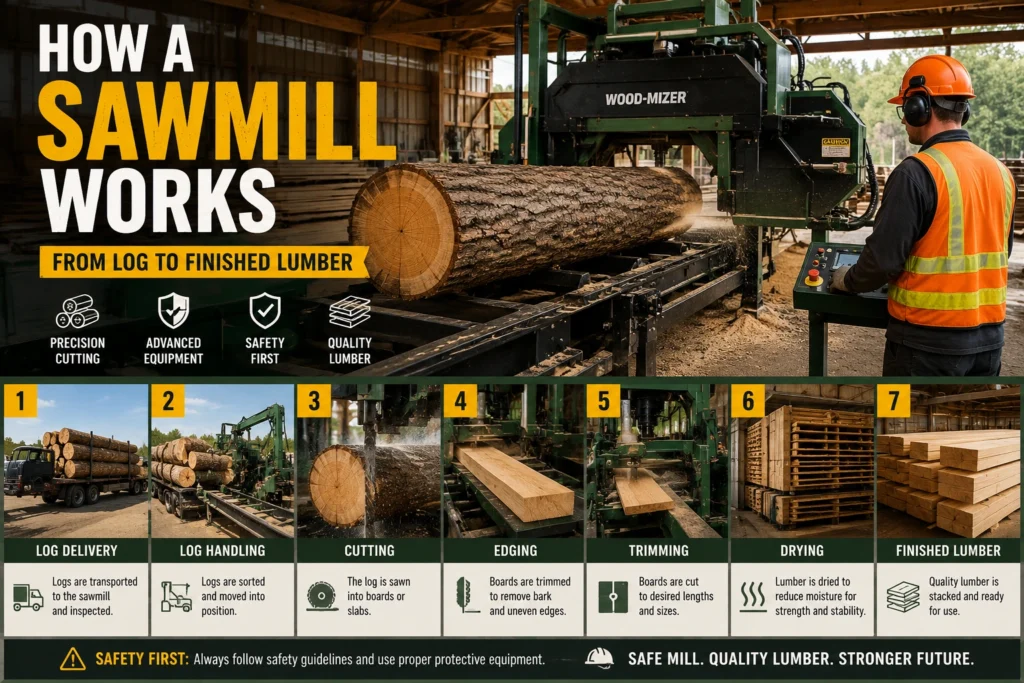
A log goes in one end. Stacked, finished lumber comes out the other. What happens in between is a surprisingly precise sequence of steps, refined over centuries to get the most usable wood out of every tree with the least waste possible.
Maybe you’re new to the industry. Maybe you’re considering starting a mill, or you’re just curious what actually happens between “tree” and “board.” This guide walks through the process in order — the same order a log actually moves through a working sawmill.
What Is a Sawmill?
A sawmill is a facility, or the core machine inside one, that cuts logs into lumber. That can mean a small portable band mill running in a farmer’s field. It can also mean a large industrial facility processing thousands of logs a day.
Every sawmill does the same basic job, regardless of size. It turns round logs into flat, usable boards, as efficiently and precisely as possible. The differences between mills come down to scale, blade type, and how many of the steps below are automated versus done by hand. Browsing reliable sawmill equipment is a good way to see that range firsthand, from small portable units to full commercial systems.
With that definition in mind, here’s what actually happens once a log arrives at the mill.
Step 1: Getting the Log to the Mill
Before any cutting happens, logs have to be harvested and transported. This stage is called logging, or timber harvesting. It typically involves felling trees with chainsaws or mechanized harvesters, then moving the logs to a landing area for transport.
At the mill itself, logs are usually unloaded, measured, and sorted by species and size before moving further into the process. Sorting matters because different species and diameters often get processed differently later on.
Step 2: Debarking the Log
Once a log reaches the front of the line, it typically goes through a debarking machine. This strips away the bark before cutting begins.
This step matters more than it might seem. Bark carries dirt, grit, and sometimes embedded metal or rock. All of that dulls blades fast and can damage cutting equipment. Removing it first protects the blade and improves cut quality from the very first pass. The bark itself isn’t wasted — mills commonly sell it as mulch or use it as fuel for on-site kilns.
Step 3: Checking for Metal
Before the log reaches the saw, it usually passes through a metal detector. Trees can live for decades or centuries. In that time, all kinds of things end up embedded in the trunk — old fence wire, nails, even bullets.
Catching metal here protects both the blade and the operator. A blade striking hidden metal at full speed can break teeth, snap the blade entirely, or send debris flying. That’s exactly the kind of hazard covered in more depth in our sawmill safety guide.
Step 4: The Primary Cut
This is the step most people picture when they think of a sawmill. The log gets clamped onto a carriage or conveyor and fed into the primary saw, often called the head rig on larger mills.
The blade doing this cutting is usually a band saw blade on portable and mid-size mills, or a circular blade on older or heavier industrial setups. Blade type here has a real impact on how much usable lumber comes out of the log. Our guide to sawmill blades covers how kerf width and blade choice affect total yield.
💡 Pro Tip Watching this step in person makes the whole process click for most people. If you’re considering starting a mill, visiting an operating one during this stage is worth more than any spec sheet.
This first pass usually produces a cant — a log squared off on at least one side. From there, the log gets broken down further.
Step 5: Edging and Resawing
Once the initial cants or flitches come off the head rig, they move to an edger. This trims the rough, bark-covered edges to create straight, uniform-width boards.
Many mills also run material through a resaw at this stage, splitting thicker cants into multiple thinner boards to maximize how much usable lumber comes out of each log. This is where blade choice and machine setup have the biggest effect on total yield. A mill running a thin-kerf band blade recovers noticeably more usable lumber than one running a wide-kerf circular blade on the same log.
Step 6: Trimming to Length
After edging and resawing, boards move to a trim saw, which cuts them to their final length. Standard lengths are common, but specialized mills can handle custom orders. Some commercial operations can trim lumber to 40 feet or more for specialty construction and timber framing work.
Step 7: Grading the Lumber
With milling complete, boards get graded. This is a quality control step that sorts lumber by appearance and structural quality. Most sawmills selling rough-cut lumber grade to a standard known as FAS, short for First and Seconds — a designation that combined what were historically two separate top grades.
Grading determines both price and end use. Higher grades go toward furniture and fine woodworking. Lower grades are perfectly suited for construction framing, pallets, or fencing.
Step 8: Drying the Lumber
Freshly cut lumber is full of moisture and isn’t ready for most uses yet. Mills handle this one of two ways.
Air drying is the simpler, lower-cost method. It means stacking lumber with spacers between boards and letting it dry naturally over weeks or months, depending on species and climate.
Kiln drying speeds this up significantly. It uses controlled heat and humidity to dry lumber in days rather than months. It also typically increases the lumber’s value, since kiln-dried wood is more dimensionally stable and often required for construction and furniture-grade applications.
⚠️ Safety Reminder Freshly cut, undried lumber is significantly heavier than dried lumber of the same size. Factor that into handling and stacking equipment, especially when moving large volumes fresh off the saw.
Where the Byproducts Go
A sawmill doesn’t just produce lumber. It produces sawdust, bark, and offcuts at every stage. Well-run mills treat these as revenue streams, not waste.
Bark and sawdust commonly get sold for mulch, animal bedding, or fuel. Offcuts and low-grade material often go toward pallets or fuel pellets. Very little of a well-managed log actually goes to true waste.
Types of Sawmills: A Quick Overview
Every mill follows the same general sequence above, but the equipment doing the work varies by scale and setup.
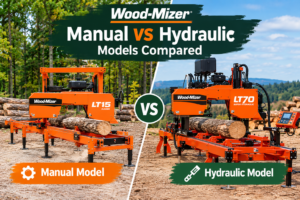
Portable band sawmills are common for smaller operations and on-site milling, using thin band blades that maximize yield. Industrial or stationary mills run the same basic process at much higher volume, often with more automation between steps. Swing blade mills use a different cutting geometry entirely, popular for highly portable, flexible setups.
If you’re comparing specific manufacturers as part of choosing equipment, our breakdown of Wood-Mizer, Baker, and TimberKing covers how the major brands differ in approach, and browsing sawmill equipment for sale shows what’s currently available across all three tiers.
How Sawmill Capacity Scales With Equipment
The steps above stay the same whether a mill processes ten logs a day or a thousand. What changes is how much of the sequence runs on its own versus requiring an operator at every stage.
Small portable mills typically need an operator involved at nearly every step — feeding the log, adjusting the carriage, moving cut boards by hand. Mid-size commercial mills usually automate log handling and some of the cutting sequence, while still relying on operators for grading and quality checks. Large industrial mills run much of the process through computer-controlled optimization, scanning each log to calculate the cutting pattern that yields the most value before the blade ever touches the wood.
None of these tiers is “better” in the abstract. The right scale depends entirely on log volume, budget, and whether the goal is a side business or a full commercial operation — a decision our guide to starting a sawmill business walks through in more detail.
Common Misconceptions About How Sawmills Work
A few misunderstandings come up often with people new to the industry:
- “Bigger logs always yield more lumber.” Log diameter matters, but so does straightness, taper, and internal defects. A smaller, clean log can outyield a larger, flawed one.
- “All sawdust is waste.” As covered above, sawdust is usually a revenue stream, not a disposal problem.
- “Kiln drying is always better.” Kiln drying is faster and often more valuable, but air drying remains standard and perfectly adequate for many uses, at a fraction of the cost.
- “A bigger blade cuts better.” Blade width and type matter more than size alone. A properly matched, well-maintained thin-kerf blade often outperforms a larger one poorly suited to the wood being cut.
Frequently Asked Questions
What is a sawmill?
A sawmill is a facility or machine that cuts logs into lumber through a sequence of steps — debarking, primary cutting, edging, trimming, grading, and drying — turning round logs into flat, usable boards.
What are the basic steps in how a sawmill works?
The general sequence is log transport, debarking, metal detection, primary cutting into cants, edging and resawing into boards, trimming to length, grading for quality, and finally drying, either by air or in a kiln.
What’s the difference between air drying and kiln drying lumber?
Air drying uses natural airflow over weeks or months and costs very little. Kiln drying uses controlled heat and humidity to dry lumber in days, typically producing more stable, higher-value lumber at a higher upfront cost.
Why do sawmills use metal detectors on logs?
Trees can grow around embedded metal — old fence wire, nails, or other debris — over decades of growth. A blade striking hidden metal at operating speed can break, throw debris, or injure the operator. Metal detection is a standard safety and equipment-protection step for exactly that reason.
What happens to sawdust and bark at a sawmill?
Most sawmills sell or repurpose these byproducts rather than discarding them. Bark commonly becomes mulch or kiln fuel, while sawdust is used for animal bedding, mulch, or fuel pellets. A well-run mill produces very little true waste.
Do all sawmills use the same type of blade?
No. Portable and mid-size mills mostly use band saw blades for their narrow kerf and better yield, while some older or heavier industrial mills still use circular blades. Swing blade mills use a different cutting motion entirely, suited to smaller and more portable setups.
Bringing It Together
A sawmill’s job looks simple from the outside: turn a log into boards. In practice, it’s a precise sequence where each step protects the next. Debarking and metal detection protect the blade. Careful cutting protects yield. Proper drying protects the final value of the lumber.
Understanding this sequence is useful whether you’re buying your first mill, evaluating equipment, or just trying to understand what you’re looking at on a mill tour. If you’re ready to compare machines built around each stage of this process, current sawmill listings are a good next stop.
For more guides like this, browse our full blog archive.
Sources
- USDA Forest Service, Northeastern Area State & Private Forestry, Thin Kerf Sawing
- OSHA, Sawmills – Overview
- Xometry, Sawmilling: Operation, Materials Used, and Applications