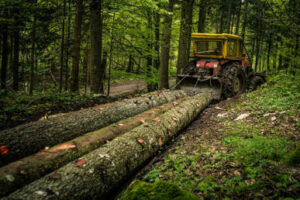
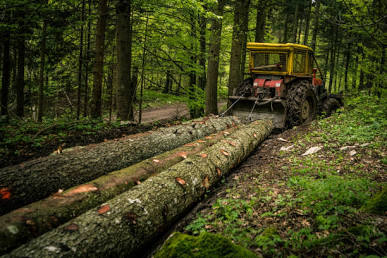
A tree comes down in the woods. Somehow, that log needs to end up at a landing, then on a truck, then at a mill. The machine that makes that first, roughest leg of the trip possible is the skidder. It’s done that job, in one form or another, for close to a century.
Maybe you’re new to logging equipment. Maybe you’re deciding between a cable and a grapple model. This guide walks through what a skidder actually is, how it works in the field, and where it fits in a working logging operation.
What Is a Skidder?
A skidder is a heavy machine used in logging. It drags, or “skids,” felled trees from where they were cut to a landing area. From there, logs are loaded onto trucks for transport to a mill. The process itself is called skidding — the first move a log makes after it hits the ground.
Modern skidders pull trees one of two main ways: with a cable and winch, or with a hydraulic grapple mounted on an arm or boom. Both approaches solve the same problem. They get heavy, awkward logs out of rough terrain. But they do it differently. That’s why cable and grapple skidders are genuinely different tools, not just different brands of the same thing.
With that definition in mind, it helps to know where this machine actually came from.
A Brief History of the Skidder
Long before diesel engines, skidding was done with teams of oxen, horses, or mules. A driver would straddle a cart over felled logs. Dangling tongs lifted one end of the log off the ground so it could be pulled — or “skidded” — behind the team.
Gasoline-powered crawlers started replacing animals in the early 1920s, though some small operations kept using horses well after that. Steel arches came next, mounted behind mechanical tractors instead of animal teams. They worked much like those old dangling tongs.
The skidder as most people picture it today — a rubber-tired machine with a cable winch or hydraulic grapple — is a mid-20th-century development. It’s still the standard approach nearly a century after gas-powered logging began.
Step by Step: How a Skidder Works in the Field
A skidder’s job starts after a tree has already been felled, usually by a chainsaw crew or a feller buncher.
1. Positioning. The skidder backs into position near a pile, or “bunch,” of felled trees.
2. Attaching the load. On a grapple skidder, the operator lowers a hydraulic grapple onto the logs and closes it around them. On a cable skidder, a second worker attaches chokers — short lengths of cable — around each log by hand.
3. Lifting and clearing. The skidder raises the load slightly off the ground. That reduces drag and protects the logs from unnecessary damage as they move.
💡 Pro Tip Watching a grapple skidder work a bunch a few times makes the whole cycle click fast — position, grab, lift, move, drop. It’s a short, repeatable loop, which is exactly why skidders are so productive once an operator has the rhythm down.
4. Skidding to the landing. The machine drives the load through the woods to a landing area near a road, where the logs will be loaded onto trucks.
5. Releasing the load. The operator drops the logs at the landing and heads back into the woods for the next load.
That loop repeats for as long as there’s timber to move. On an active job site, it often happens dozens of times a day.
Cable Skidders: How They Work
A cable skidder pulls logs using a skid line with chokers attached to the end. A worker on the ground, sometimes called a chokerman, wraps a choker around each log and hooks it to the main line.
Cable skidders have a curved fairlead that lifts the front end of the logs slightly as the cable pulls them in. That reduces digging into the ground and cuts down on drag. This setup makes cable skidders well suited to steep or difficult terrain, since the line can reach logs the machine itself can’t safely drive to.
The tradeoff is labor. Someone has to work outside the cab to set and release chokers on every load. That adds both time and a real safety consideration — more on that shortly. If cable skidding fits your terrain, browsing cable skidders for sale shows current listings from manufacturers built specifically for this kind of work.
Grapple Skidders: How They Work
A grapple skidder replaces the cable and chokers with a hydraulic grapple, usually mounted on the back of the machine or on a swinging boom. The operator lowers the grapple onto a bunch of logs, closes it, and lifts the load — all from inside the cab.
This design is common on sites where a feller buncher has already grouped trees into bunches. The grapple can grab an entire bunch at once without anyone leaving the cab. That keeps ground workers out of the immediate work zone during the skidding cycle, which is a meaningful safety advantage over cable operations.
Grapple skidders generally move faster per cycle than cable skidders on flatter ground. But they’re more limited on steep or broken terrain, where a cable’s reach matters more than raw speed. If your ground is manageable and speed matters most, grapple skidders for sale is worth a look for current inventory from leading brands.
Key Skidder Specifications to Understand
Spec sheets can be overwhelming for anyone new to the equipment. A few numbers matter more than the rest when you’re trying to understand what a skidder can actually do.
Horsepower determines how much pulling power the machine has, but it’s not the whole story. A high-horsepower engine paired with a weak drivetrain won’t outperform a well-matched, lower-horsepower machine.
Drawbar pull is a more direct measure of a skidder’s actual towing capability. This figure tells you how much force the machine can exert while pulling a load. It matters more than horsepower alone when comparing machines for heavy timber.
Arch or grapple capacity sets the practical limit on how much wood the machine can lift and carry per cycle. A higher-capacity arch means fewer trips for the same volume of timber, which directly affects daily productivity.
Tire size and type affect both flotation on soft ground and overall ground pressure. Wider, higher-flotation tires reduce ground disturbance on wet sites, while narrower tires may offer better traction on firm, dry terrain.
None of these numbers matter in isolation. A machine matched well to your specific terrain, timber size, and daily volume will consistently outperform one chosen on horsepower or price alone.
Track vs. Wheel: Choosing the Right Undercarriage
Most skidders run on large rubber tires, but tracked skidders exist for specific ground conditions. Tracked machines deliver more pulling power per horsepower. They also put less pressure on the ground. That matters on soft or wet soil, where a wheeled machine would get stuck or cause excessive ground disturbance.
Wheeled skidders remain the more common choice for general-purpose logging. They’re typically faster on firm ground and less expensive to maintain than tracked equipment. The right choice comes down to the specific terrain and soil conditions on a given job. It’s not about a universal preference for one undercarriage over the other.
Built-In Safety Systems
Logging ranks among the most dangerous jobs in the country, and skidder operation carries real risk. Roughly four in ten logging injuries happen to equipment operators, and a large share of those involve skidders specifically. Many occur during maintenance or repair work rather than active skidding (Virginia Tech Extension).
Federal regulation reflects that risk directly. OSHA’s logging standard requires that skidders placed into service after February 1995 have rollover protective structures, falling object protective structures, or both. These must be tested and maintained to specific engineering standards.
A few other built-in safety requirements worth knowing:
- Seat belts are required on ROPS-equipped skidders, and operators must use them every time the machine is running
- Signaling rules require that no log be moved until every worker in the area is confirmed clear
- Choker attachment procedures specify how logs must be secured. This includes which side of the log a choker should be hooked or unhooked from on a slope
⚠️ Safety Reminder Nearly half of equipment-operator injuries in logging happen while getting on or off the machine, or during maintenance — not during active skidding. Slow down around mounting points and shut down properly before doing any hands-on work.
Where Skidders Fit in the Logging Process
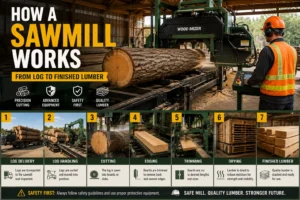
A skidder doesn’t work alone. On a typical mechanized site, a feller buncher or chainsaw crew fells and bunches trees first. The skidder then moves those bunches to a landing. A log loader sorts and loads them onto trucks bound for a mill. That’s a process our guide to how a sawmill works picks up from that point forward.
Understanding this sequence matters when you’re building or expanding a fleet. A skidder is rarely a standalone purchase. It’s one piece of a chain that only moves as fast as its slowest link.
Keeping a Skidder Running: The Basics
A skidder works under constant, heavy load, which means routine care has a direct effect on both uptime and resale value down the road.
Hydraulic systems take the brunt of the wear on a grapple skidder, since every lift and clamp cycle runs through them. Regular fluid checks and prompt attention to leaks prevent small problems from becoming expensive ones.
Cables and chokers on a cable skidder need regular inspection for fraying, kinking, or broken strands. A worn cable under load is a genuine safety hazard, not just a maintenance inconvenience.
Undercarriage and tires wear differently depending on terrain. Tracked machines in particular need regular inspection of pins, bushings, and track tension to avoid premature failure.
Engine and drivetrain service follows the same logic as any heavy equipment. Consistent oil changes, filter replacement, and cooling system checks extend the life of components that are expensive to replace.
A well-maintained used skidder, bought from a seller who can show service history, is often a better investment than a poorly maintained newer one. Condition and care matter as much as age when you’re evaluating what a machine is actually worth.
Common Misconceptions About Skidders
A few misunderstandings come up often with people new to logging equipment:
- “Grapple skidders are always better than cable skidders.” Grapple machines are faster on manageable ground, but cable skidders reach terrain a grapple machine can’t safely access.
- “Bigger skidders are always more productive.” Machine size needs to match the terrain, average log size, and distance to landing. An oversized machine on tight, steep ground often underperforms a right-sized one.
- “Skidder safety is mostly about the machine’s rollover protection.” ROPS and FOPS matter, but most operator injuries happen during mounting, dismounting, or maintenance, not rollovers.
- “All skidders use the same attachment method.” Cable and grapple skidders solve the same problem in fundamentally different ways. Choosing between them affects crew size, terrain capability, and cycle speed.
Frequently Asked Questions
What is a skidder used for?
A skidder is used in logging to drag felled trees from the cutting site to a landing area, where the logs are loaded onto trucks for transport to a mill. This process is called skidding, and it’s typically the first move a log makes after felling.
What’s the difference between a cable skidder and a grapple skidder?
A cable skidder pulls logs using a cable line with chokers attached by hand, which works well on steep or difficult terrain but requires a ground worker. A grapple skidder uses a hydraulic grapple the operator controls from the cab, generally faster on manageable ground and safer since it keeps workers out of the immediate work zone.
Are skidders dangerous to operate?
Logging is one of the most dangerous jobs in the United States, and skidder operators account for a significant share of logging injuries. Many of those injuries happen during mounting, dismounting, or maintenance rather than active skidding.
Do all skidders have rollover protection?
Under OSHA’s logging standard, skidders placed into service after February 1995 are required to have rollover protective structures, falling object protective structures, or both, tested and maintained to specific engineering criteria.
Should I buy a wheeled or tracked skidder?
It depends on ground conditions more than personal preference. Tracked skidders offer more pulling power per horsepower and lower ground pressure, useful on soft or wet soil. Wheeled skidders are typically faster on firm ground and less expensive to maintain.
I’m new to logging — is a skidder the same thing as a log loader?
No, they’re different machines with different jobs. A skidder drags felled trees from where they were cut to a landing area. A log loader takes over from there, sorting and lifting logs onto trucks. On most job sites, you’d need both — a skidder gets the wood out of the woods, and a loader gets it onto the truck.
Should I get a cable skidder or a grapple skidder for my operation?
It really comes down to your terrain and your budget for labor. If you’re working steep or difficult ground, a cable skidder can reach logs a grapple machine can’t safely drive to, but you’ll need someone on the ground setting chokers. If your ground is manageable and you want to move faster with a smaller crew, a grapple skidder lets the operator do everything from the cab. Neither one is objectively better — it depends on what you’re actually working with.
How much does a used skidder typically cost?
Pricing varies a lot based on brand, hours, condition, and whether it’s a cable or grapple model, so there’s no single number that applies across the board. What matters more than chasing the lowest price is comparing machines with clear service history against ones with none — a well-maintained used skidder is usually a better deal than a cheaper one with unknown wear.
Can one person operate a skidder by themselves?
A grapple skidder can be run entirely by one operator from the cab, since the grapple does the work a second person would otherwise do by hand. A cable skidder is harder to run solo, because someone typically needs to be on the ground attaching and releasing chokers on each load.
How long do skidders usually last before they need major work?
It depends heavily on how well they’ve been maintained rather than age alone. A skidder that’s had consistent hydraulic, cable, and drivetrain care can stay productive for many years past what its hour count might suggest, while a neglected machine can develop serious problems much sooner. That’s why service history matters more than the model year when you’re shopping used.
Is it hard to learn how to operate a skidder?
The basic cycle — position, attach, lift, move, release — isn’t complicated to understand, but operating safely and efficiently on real terrain takes practice. OSHA requires operators to be trained on the specific machine they’re using, and most experienced operators will say the skill comes from time in the seat, not from reading a manual.
Do I need a special license to drive a skidder?
Skidders are generally operated off public roads on private or leased logging land, so they don’t typically require the same license as a road vehicle. That said, OSHA does require documented, machine-specific operator training under the logging standard, and some states or employers may have their own certification requirements on top of that.
What’s a realistic first skidder for someone just starting out?
Most new operators do better starting with a mid-size, well-maintained used machine rather than the biggest one they can afford. A right-sized skidder that matches your typical log size and terrain will usually be easier to learn on and more cost-effective than an oversized machine bought on the assumption that bigger is always better.
Bringing It Together
A skidder’s job looks simple from a distance: grab a log, move it, drop it, repeat. In practice, the choice between cable and grapple, wheeled and tracked, shapes everything from crew size to safety exposure to how fast wood actually moves off a job site.
Understanding how the machine works, and where it fits between felling and the landing, makes it much easier to evaluate the right skidder for your operation, whether you’re buying your first one or expanding a fleet.
If you’re ready to compare available machines, browsing skidders for sale is a good next step, with listings spanning cable, grapple, and track models from trusted manufacturers.
Looking for a Skidder?
Browse our full range of new and used skidders, including cable and grapple models.
For more guides like this, browse our full blog archive.
Sources
- OSHA, 1910.266 – Logging Operations
- OSHA, eTool: Logging – Mechanical Operations, Grapple Skidder
- USDA Forest Service, Forest Operations Equipment Catalog: Skidders
- Virginia Cooperative Extension, Virginia Tech, Skidder Safety and Efficiency: A Discussion Leader’s Guide